Skip to product information
1 of 7

DJI Zenmuse L3 with Dronefly Care Plus

DJI Zenmuse L3 with Dronefly Care Plus

Regular price $19,899.00
Regular price Sale price $19,899.00
Sale Sold out
  • Comes with Dronefly Care Plus 13-month extended coverage with replacement option
  • LiDAR detects up to 950 meters in field
  • Dual 100 MP cameras capture wide-area RGB detail
  • Shutter speeds reach 1/16000 s for clarity
  • RTK accuracy achieves 1 cm positional results consistently
  • 107° FOV reduces required survey flight lines significantly
  • Scan modes support 80° × 80° capture patterns
  • IP54 rating withstands dust, rain, and debris exposure
  • CFexpress writes at 1500 MB/s for stability
  • Photo interval reaches 0.5 seconds for speed
View full details
  • Description
  • Specifications
  • In the Box
  • FAQ

DJI Zenmuse L3 with Dronefly Care Plus: professional LiDAR scanning and detailed RGB mapping

The DJI Zenmuse L3 is a long-range LiDAR and dual 100 MP RGB mapping payload designed for teams that require accurate 3D data collection across challenging landscapes. Built for the Matrice 400 Series, the system integrates LiDAR, dual high-resolution cameras, and a synchronized POS module to streamline aerial surveying and inspection tasks.

This package includes complete mounting and storage equipment along with Dronefly Care Plus, providing 13 months of accidental-damage protection for enterprise missions requiring dependable uptime.

Key features and technical benefits

  • Long-range LiDAR provides dependable scanning performance across large terrain areas.
  • Dual 100 MP cameras capture wide-area RGB data with detailed clarity.
  • Shutter flexibility supports distortion control in dynamic flight environments.
  • Integrated POS enhances accuracy for survey-grade mapping workflows.
  • Broad horizontal field of view increases overall coverage efficiency.
  • Scan modes support flexible LiDAR capture across varied mission types.
  • IP54 resistance ensures durability in rugged field conditions.
  • CFexpress Type B storage handles large sensor outputs effectively.
  • Short capture intervals improve productivity across extensive survey missions.
  • DJI ecosystem integration supports efficient planning and processing pipelines.

Advanced sensing performance for high-quality terrain and structural mapping

The L3’s 1535 nm LiDAR achieves detection up to 950 meters at low reflectivity and up to 2000 meters under favorable conditions, enabling efficient surveying across diverse sites. Its dual 100 MP 4/3 CMOS imaging system widens the capture footprint to a combined 107-degree horizontal field of view, reducing required flight lines during mapping operations.

With mechanical and electronic shutter options, rapid photo intervals, CFexpress Type B storage, multiple scan patterns, and pulse rates ranging from 240–480 kHz depending on DJI’s mode specifications, the L3 supports demanding geospatial and engineering workflows.

Precision reliability and operational resilience with extended protection

Accurate 3D outputs are supported by the integrated POS module, which achieves centimeter-level positioning when paired with RTK correction. Environmental durability is reinforced through IP54 protection and a broad operating temperature range.

Dronefly Care Plus adds structured protection for 13 months, covering accidental damage from collisions, drops, water exposure, signal interference, and internal issues with one replacement available. This helps maintain operational continuity for organizations with time-sensitive missions.

Platform connectivity and operational ecosystem

  • Built for Matrice 400 Series, installed using the included single-port gimbal mount.
  • Supports DAT, RINEX, RTCM, and OEM GNSS formats for RTK and PPK workflows.
  • Managed through DJI Pilot 2 for flight control and capture oversight.
  • Data processed with DJI Terra for LiDAR and RGB reconstruction.
  • DJI Modify refines mapped datasets through point cloud editing.
  • DJI FlightHub 2 offers cloud-based operations and mission coordination.
  • CFexpress Type B media provides consistent high-throughput data handling.
  • Final outputs compatible with common GIS and engineering software environments.

Industry applications and mission scenarios

  • Survey mapping: detailed topography captured from high-density point clouds.
  • Utility inspection: 3D modeling for overhead lines, substations, and structures.
  • Construction workflows: site documentation and progress updates for AEC teams.
  • Forestry analysis: canopy structure and terrain insights from LiDAR penetration.
  • Mining operations: volumetric assessments and terrain monitoring tasks.
  • Municipal planning: land-use assessments and infrastructure planning support.
  • Emergency operations: rapid scene modeling for post-incident documentation.
  • Linear corridor mapping: efficient surveys of railways, pipelines, and powerlines.
  • Infrastructure modeling: accurate datasets for maintenance planning.
  • Environmental studies: elevation and terrain data for hydrology and erosion work.

Engineered for enterprise use and streamlined workflows

The Zenmuse L3 integrates LiDAR, imaging, and positional alignment systems to support complex aerial data acquisition with minimal payload complexity. Its environmental resilience and high data throughput make it suitable for routine enterprise deployment.

Dronefly Care Plus further strengthens operational reliability, offering accident protection that reduces downtime and supports mission-critical operations throughout the coverage period.

The Zenmuse L3 with Dronefly Care Plus delivers accurate LiDAR scanning, wide-area RGB mapping, and extended operational protection for enterprise users who rely on consistent aerial data. Order from Dronefly today — the West Coast’s trusted enterprise UAV source.

System Specifications

  • Product name: Zenmuse L3
  • Point cloud vertical accuracy at 120 m flight altitude: 3 cm (RMSE)
  • Point cloud horizontal accuracy at 120 m flight altitude: 4 cm (RMSE)
  • Point cloud vertical accuracy at 300 m flight altitude: 5 cm (RMSE)
  • Point cloud horizontal accuracy at 300 m flight altitude: 7.5 cm (RMSE)
  • Accuracy measured with Matrice 400 linked to position-calibrated D-RTK 3 Multifunctional Station
  • Flight route planned in DJI Pilot 2 Area Route with IMU calibration and linear scanning
  • Test flight speed: 15 m/s, gimbal pitch: -90°, straight segment length < 3300 m
  • Checkpoints: exposed hard ground targets conforming to diffuse reflection model
  • Post-processing in DJI Terra with point cloud accuracy optimization enabled
  • Point cloud thickness at 120 m nadir altitude: 1.2 cm@1σ
  • Point cloud thickness at 300 m nadir altitude: 2 cm@1σ
  • Thickness measured in linear scanning on 80% reflectivity objects with no optimization or downsampling
  • For 6σ thickness estimation, multiply listed values by 6
  • Combined horizontal FOV dual RGB mapping cameras: 107°
  • RGB FOV composed from two cameras with 45° optical axis angle between them
  • RGB ground sampling distance average: 3 cm at 300 m nadir altitude
  • GSD calculation details available in user manual on official Zenmuse L3 download page
  • Payload weight without single gimbal connector: 1.60 kg
  • Zenmuse L3 single gimbal connector weight: 145 g
  • Payload dimensions: 192×162×202 mm (L×W×H)
  • Dimensions measured in default stabilized state after power-on with non-orthogonal gimbal design
  • Typical power consumption: 64 W
  • Max power consumption: 100 W
  • Supported aircraft: DJI Matrice 400 (requires Zenmuse L3 single gimbal connector)
  • Ingress protection rating: IP54
  • Operating temperature: -20° to 50° C (-4° to 122° F)
  • Storage temperature: -40° to 70° C (-40° to 158° F)

LiDAR

  • Laser wavelength: 1535 nm
  • Laser beam divergence: 0.25 mrad (1/e²)
  • Laser spot size at 120 m: Φ 41 mm (1/e²)
  • Laser spot size at 300 m: Φ 86 mm (1/e²)
  • Detection range: 700 m@10% reflectivity, 350 kHz pulse rate
  • Detection range: 950 m@10% reflectivity, 100 kHz pulse rate
  • Detection range: 2000 m@80% reflectivity, 100 kHz pulse rate
  • Range definition: distance where 50% of emitted pulses are detected
  • Note: multi-target returns split transmitter power and reduce effective range
  • Detection tests at 100 klx ambient light and 23 km atmospheric visibility
  • Detection tests use flat targets larger than beam diameter with perpendicular incidence
  • Default max detection range: 900 m, longer range requires DJI support authorization
  • Wire detection for 21.6 mm steel core aluminum stranded wire: 300 m@100 klx, 350 kHz
  • Wire detection for 18.4 mm black PVC insulated wire: 100 m@100 klx, 350 kHz
  • Wire detection definition: range where mapped segment achieves 4 points per meter
  • Wire tests at 100 klx, 23 km visibility, non-repetitive scanning, 15 m/s along-wire flight
  • Wire test conditions assume clean, non-aged wires and LiDAR center FOV perpendicular to wire
  • Absolute ranging accuracy: ±10 mm
  • Ranging repeatability: < 5 mm (1σ)
  • Ranging specs measured at 25° C, 350 kHz, 80% reflectivity, distances of 120 m and 300 m
  • Actual field performance may differ; figures are for reference
  • Minimum effective detection distance: 10 m
  • Laser pulse frequency 100 kHz: recommended flight altitude < 500 m
  • Laser pulse frequency 350 kHz: recommended flight altitude < 300 m
  • Laser pulse frequency 1000 kHz: recommended flight altitude < 100 m
  • Laser pulse frequency 2000 kHz: recommended flight altitude < 50 m
  • Configurable number of returns: 4, 8, 16 returns at 100 kHz and 350 kHz
  • Configurable number of returns: 4, 8 returns at 1000 kHz
  • Configurable number of returns: 4 returns at 2000 kHz
  • Cross-cycle calculation count: 7 times
  • Linear scanning FOV: 80° horizontal, 3° vertical
  • Star-shaped scanning FOV: 80° horizontal, 80° vertical
  • Non-repetitive scanning FOV: 80° horizontal, 80° vertical
  • Laser safety classification: Class 1 (IEC 60825-1:2014)

RGB Mapping Camera

  • RGB mapping sensor type: 4/3 CMOS
  • Lens equivalent focal length: 28 mm
  • Lens FOV diagonal: 73.3°
  • Lens FOV horizontal: 62°
  • Lens FOV vertical: 41.2°
  • Lens aperture range: f/2.0-f/11
  • Mechanical shutter speed at f/2.0: 2-1/1500 s
  • Mechanical shutter speed at f/2.8-f/11: 2-1/2000 s
  • Mechanical shutter durability rating: 500,000 actuations
  • Electronic shutter speed range: 2-1/16000 s
  • Photo size 100 MP: 12288×8192 pixels
  • Photo size 25 MP: 6144×4096 pixels
  • Minimum JPEG photo interval at 25 MP: 0.5 s
  • Minimum JPEG photo interval at 100 MP: 1 s
  • Minimum RAW or JPEG+RAW photo interval: 1.2 s
  • Video format: MP4 (MPEG-4 HEVC/H.265)
  • Video resolution 4K: 3840×2160@30fps
  • Video resolution FHD: 1920×1080@30fps

Position and Orientation System (POS)

  • GNSS update rate: 5 Hz
  • POS update rate: 200 Hz
  • Attitude error yaw angle: 0.02° (post-processed, 1σ)
  • Attitude error pitch and roll angle: 0.01° (post-processed, 1σ)
  • Horizontal positioning accuracy: 1.0 cm + 1 ppm (RTK fix)
  • Vertical positioning accuracy: 1.5 cm + 1 ppm (RTK fix)
  • Supported PPK differential format DAT: generated in base station mode by D-RTK 3 and D-RTK 2
  • Supported PPK differential format RINEX: v2.1x and v3.0x
  • Supported PPK differential format RTCM: v3.0, v3.1, v3.2, v3.3 (MSM3, MSM4, MSM5, MSM6, MSM7)
  • Supported PPK differential OEM formats: OEM4 and OEM6
  • Recommended maximum distance between Multifunctional Station and aircraft: 15 km
  • Multifunctional Station must support more than two GNSS constellations for field operation

Gimbal

  • Gimbal degrees of freedom: 3-axis (pitch, roll, yaw)
  • Gimbal angular accuracy: ±0.01°
  • Mechanical pitch range: -135° to +73°
  • Mechanical roll range: -90° to +60°
  • Mechanical yaw range: -105° to +105°
  • Mechanical ranges defined as structural limits, not controllable ranges
  • Controllable pitch range: -120° to +60°
  • Controllable yaw range: -80° to +80°
  • Roll axis is uncontrollable and used for stabilization only
  • Roll axis self-check: not required
  • Yaw axis self-check: uses limit stop
  • Pitch axis self-check: not required
  • Mounting method: detachable DJI SKYPORT with Zenmuse L3 single gimbal connector

Data Storage

  • Raw data stored: photos, IMU, point cloud, GNSS and calibration files
  • Standard memory card: CFexpress Type B
  • Required CFexpress sequential write speed: 1500 MB/s
  • Standard card reader minimum read/write speed: > 900 MB/s

Software Ecosystem

  • Data collection software: DJI Pilot 2
  • Data processing software: DJI Terra
  • Data application software: DJI Modify
  • Cloud application platform: DJI FlightHub 2

Data Format

  • DJI Terra export point cloud formats: PNTS
  • DJI Terra export point cloud formats: LAS
  • DJI Terra export point cloud formats: LAZ
  • DJI Terra export point cloud formats: PLY
  • DJI Terra export point cloud formats: PCD
  • DJI Terra export point cloud formats: S3MB
  • DJI Modify import point cloud formats: LAS
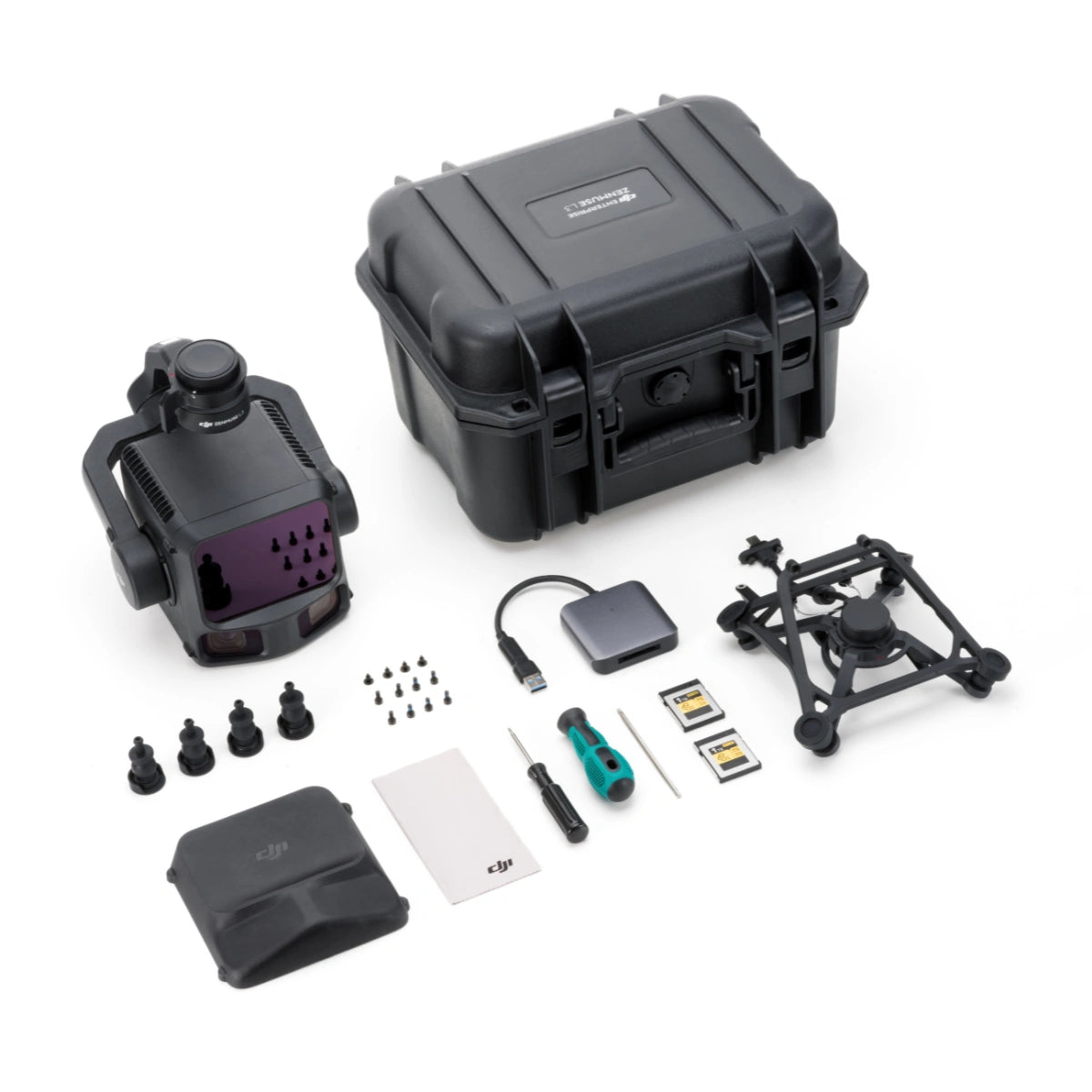
  • 1× Zenmuse L3 payload
  • 1× Zenmuse L3 single-port gimbal mount, including shock-absorbing ball set (L3-compatible only)
  • 2× CF-Express Type B memory card (1 TB each)
  • 1× CF-Express Type B card reader
  • 1× Screw tool set
  • 1× Storage box
  • 1× Lens cloth
  • 1× M400 transport box inner liner (for L3 fit)
  • 1x DSLRPros Care Plus for Zenmuse L3
How accurate is the DJI Zenmuse L3 during field operations?

It achieves centimeter-level accuracy when paired with RTK corrections, supported by precise attitude measurements from its integrated POS module.

What components are included with the DJI Zenmuse L3 from Dronefly?

The payload, single-port mount, two CFexpress cards, card reader, tool set, storage items, transport liner, and Dronefly Care Plus are included.

How does Dronefly Care Plus support the DJI Zenmuse L3?

Coverage protects against accidental damage from collisions, drops, water exposure, interference, and internal malfunctions for 13 months with one replacement available.

Is the DJI Zenmuse L3 compatible with multiple DJI aircraft?

It is designed exclusively for the Matrice 400 Series platform and requires the included single-port mount.

Which software applications are used with DJI Zenmuse L3 data?

DJI Terra processes LiDAR and RGB data, DJI Modify refines point clouds, and DJI FlightHub 2 manages cloud-based mission coordination.