Skip to product information
1 of 1

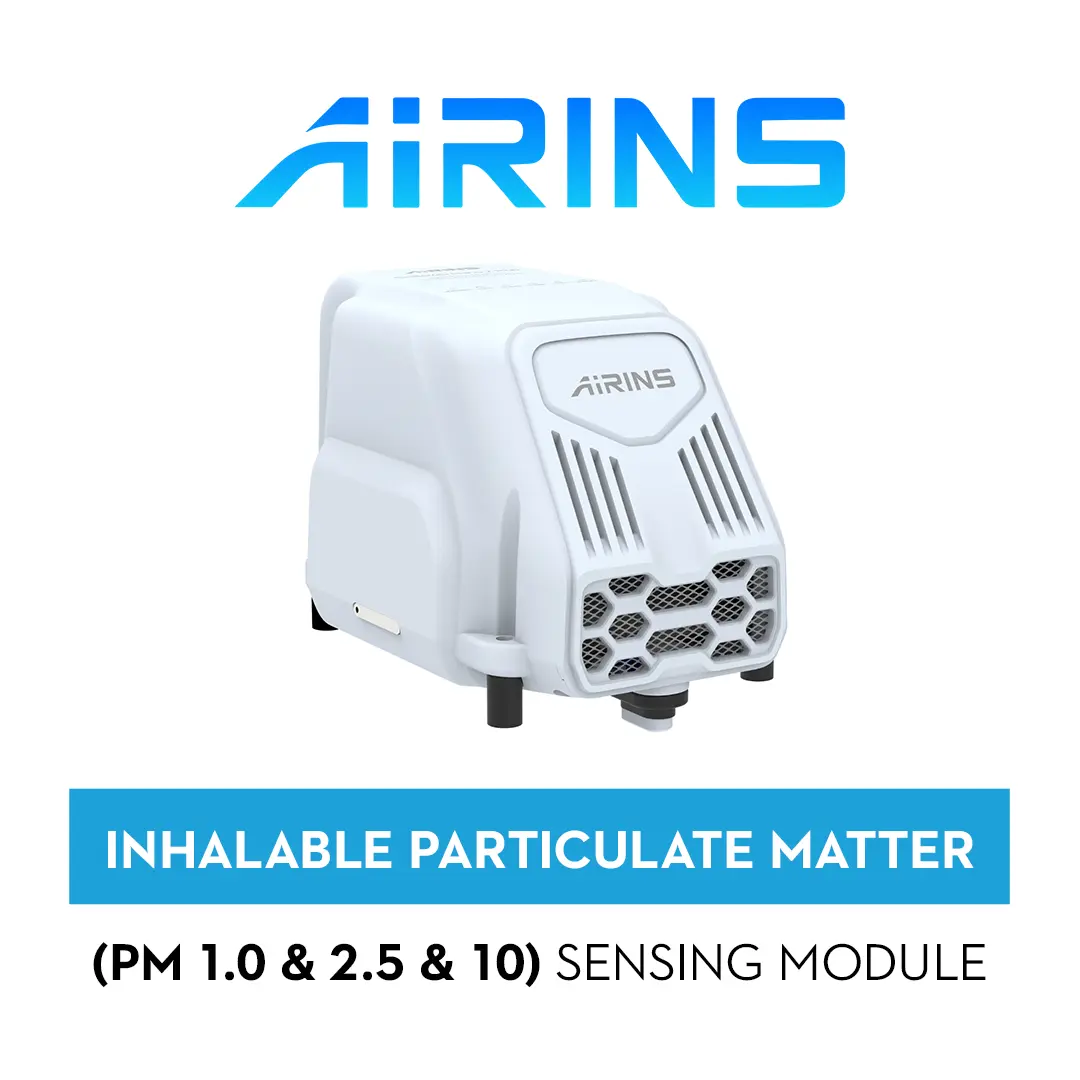
AIRINS Sniffer4D Inhalable Particulate Matter (PM 1.0 & 2.5 & 10) Sensing Module

AIRINS Sniffer4D Inhalable Particulate Matter (PM 1.0 & 2.5 & 10) Sensing Module

Regular price $548.00
Regular price Sale price $548.00
Sale Sold out
  • Light scattering sensor measures PM 1.0, 2.5, and 10
  • Five microgram detection limit flags low concentration events
  • Sub ten second response keeps pace with survey flights
  • Onboard humidity correction standardizes accuracy across a fleet
  • Service life beyond three years supports multi site programs
  • Repeatability under two percent keeps fleet wide readings consistent
  • Fine one microgram resolution resolves subtle concentration shifts precisely
  • Single slot footprint preserves flexibility for other sensor modules
  • Fast warm-up gets units mission ready after power-on
  • Compact module scales across every Matrice airframe in fleet
View full details
  • Description
  • Specifications
  • In the Box
  • FAQ

Sniffer4D Inhalable Particulate Matter Sensing Module: Standardize Particulate Monitoring Across Your Sensor Fleet

The Sniffer4D Inhalable Particulate Matter (PM 1.0, 2.5, and 10) Sensing Module expands a Sniffer4D Nano 2 Plus Base Unit's five slot array with dedicated particulate detection, measuring three particle size ranges in a single pass. Fleet programs standardizing on one sensor platform can add this module to any Base Unit build without introducing a separate air quality device into the workflow.

Programs running Base Units across multiple sites benefit from the module's on-chip humidity correction algorithm, which keeps particulate readings consistent whether units are deployed in dry inland regions or humid coastal zones. A Base Unit is required separately for each aircraft in the fleet, since the module itself is not a standalone flying sensor.

Key Features and Benefits

  • Light scattering sensor: measures PM 1.0, PM 2.5, and PM 10 together.
  • Detection limit of 5 ug/m3: flags low concentration particulate events reliably.
  • Linear range to 1000 ug/m3: covers light haze through heavy particulate loads.
  • Response under 10 seconds: keeps pace with fast moving survey flights.
  • On-chip humidity correction: standardizes accuracy across a distributed sensor fleet.
  • Service life over 36 months: supports long term multi-site deployment plans.
  • Repeatability under 2% FS: keeps readings consistent across a fleet of units.
  • 1 ug/m3 resolution: resolves fine shifts in particulate matter concentration.
  • Single slot footprint: adds particulate sensing without reconfiguring the module array.
  • Warm-up under 10 seconds: gets units mission ready shortly after power-on.

The PM Sensing Module gives environmental and industrial hygiene programs a way to standardize particulate screening across every aircraft in a fleet. Adding PM 1.0 through PM 10 coverage to a single Base Unit slot keeps sensor configurations consistent without sacrificing flexibility for other gas modules.

Standardizing particulate detection across a fleet starts with consistent hardware, and Dronefly stocks the PM Sensing Module ready to pair with your Base Units. As your dedicated drone partner, we equip programs with the sensor configurations they need to scale monitoring across every site. Order the PM Sensing Module through Dronefly today.

  • Detection principle: laser scattering / light scattering
  • Measures: PM 1.0 (particle size 0.3 to 1 µm), PM 2.5 (particle size 0.3 to 2.5 µm), PM 10 (particle size 0.3 to 10 µm)
  • Particle counting effectiveness: 50% at 0.3 µm, 98% at greater than 0.5 µm
  • Linear range: 5 to 1,000 µg/m³
  • Limit of detection: 5 µg/m³
  • Repeatability: less than 2% FS
  • Display resolution: 1 µg/m³
  • Warm-up time from cold start: less than 10 seconds
  • Overall response time: less than 10 seconds
  • Estimated service life: greater than 36 months
  • On-chip proprietary humidity correction algorithm for better data quality across a wide humidity range
  • 1x AIRINS Sniffer4D Inhalable Particulate Matter (PM 1.0 & 2.5 & 10) Sensing Module
Does a fleet need a separate Base Unit for every PM Sensing Module deployed?

Yes. Each Sniffer4D Nano 2 Plus Base Unit provides its own power, connectivity, and data handling, so a PM Sensing Module installed in one Base Unit cannot be shared across multiple aircraft mid-mission. Fleet programs scaling particulate monitoring typically standardize a module configuration and replicate it across every Base Unit in the fleet. Dronefly can help you plan module allocation across your aircraft roster before ordering.

How consistent are particulate readings across units deployed at different sites?

The module's on-chip humidity correction algorithm is designed to hold accuracy steady across varying environmental conditions, from dry inland deployments to humid coastal ones. This matters for fleet programs comparing data across multiple sites, since inconsistent humidity compensation would undermine cross-site comparisons. Repeatability is rated under 2 percent FS, which supports consistent readings unit to unit. Standardizing on this module across a fleet keeps your dataset comparable across every deployment location.

Does flight speed impact particulate readings across a fleet of units?

Yes, to a limited degree across every unit using this sensor. The diffusion-based air intake is not fully isokinetic, so sudden acceleration, sharp turns, or speeds above 10 m/s can introduce brief fluctuations of roughly 5 to 10 µg/m³. Standardizing flight speed at or below 8 m/s across a fleet's flight procedures keeps particulate data consistent between operators and aircraft. Building this into your standard operating procedure helps normalize data across the program.

Which Matrice platforms support this module across a mixed fleet?

The module operates through whichever Base Unit it is installed in, and the Base Unit connects natively to the Matrice 4D and 4TD through the E-Port. Matrice 400, Matrice 4E and 4T, and Matrice 350 and 300 airframes require a separately sold integration kit for the Base Unit itself. This lets a fleet running multiple Matrice generations standardize on the same particulate sensor across every airframe. Dronefly can confirm kit compatibility for each aircraft in your fleet.

How many particle size ranges does the module cover in a single flight?

The module reports three particle size ranges simultaneously: PM 1.0, PM 2.5, and PM 10, spanning particle sizes from 0.3 to 10 microns. This gives fleet programs a single standardized dataset per flight rather than requiring multiple passes or separate sensors. Programs needing coverage up to 100 microns should instead standardize on the separate TSP/PM 100 module, which uses all five Base Unit slots. Dronefly can help determine which module fits your program's monitoring requirements.