Skip to product information
1 of 1

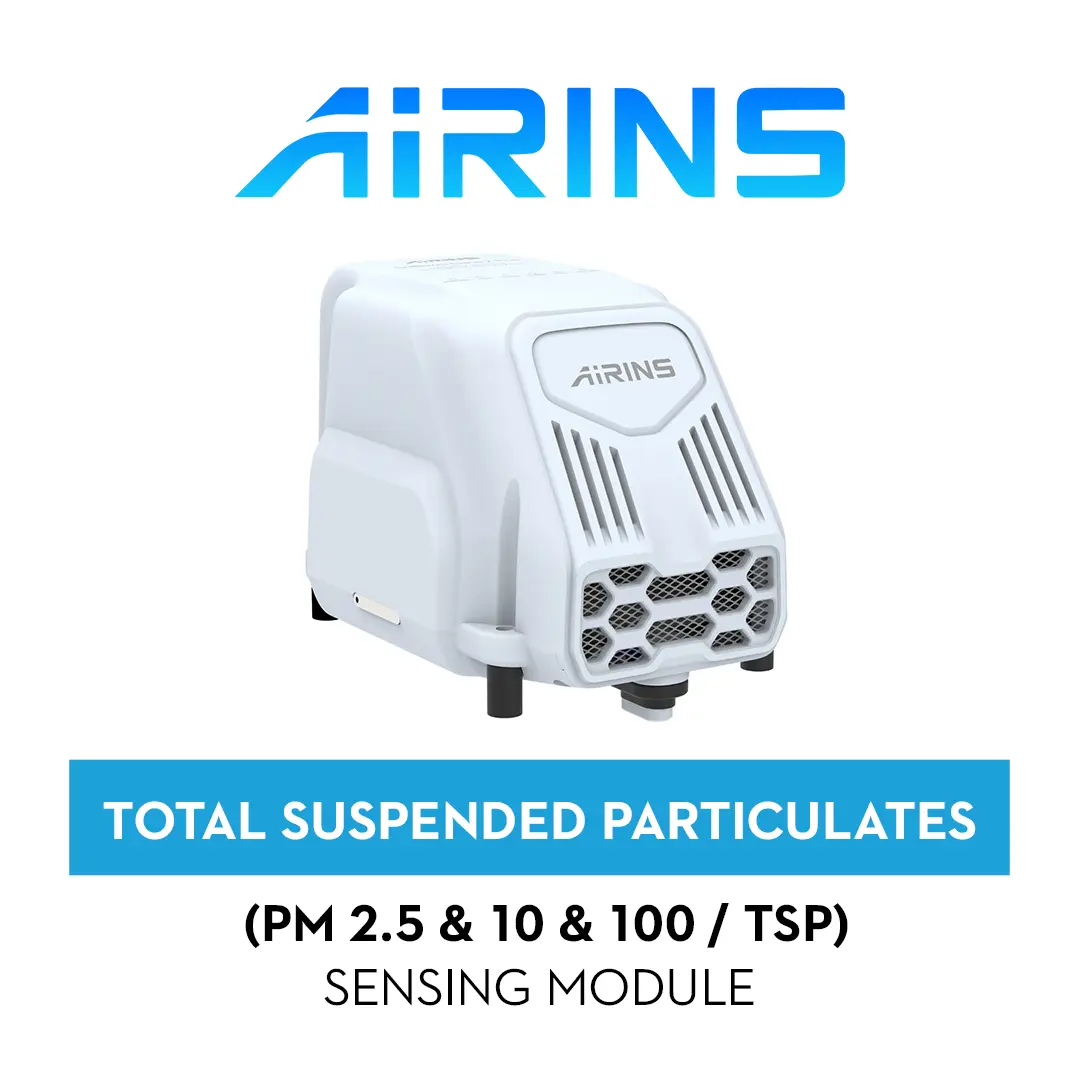
AIRINS Sniffer4D Total Suspended Particulates (PM 2.5 & 10 & 100 / TSP) Sensing Module

AIRINS Sniffer4D Total Suspended Particulates (PM 2.5 & 10 & 100 / TSP) Sensing Module

Regular price $863.00
Regular price Sale price $863.00
Sale Sold out
  • Light scattering sensor measures PM 2.5, 10, and 100
  • Fifty microgram limit flags coarse particulate events fleet wide
  • Wide linear range matches heavy dust across job sites
  • One second resolution captures rapid particulate shifts quickly
  • Sub ten second response keeps pace with flight paths
  • Twenty thousand hour life supports standardized fleet deployment
  • Wide temperature range performs across hot and cold sites
  • Humidity resilient design holds accuracy in wet conditions
  • Dedicated five slot build standardizes detection fleet wide
View full details
  • Description
  • Specifications
  • In the Box
  • FAQ

Sniffer4D Total Suspended Particulates (TSP) Sensing Module: Standardize Coarse Dust Monitoring Across Your Fleet

The Sniffer4D Total Suspended Particulates (PM 2.5, 10, and 100/TSP) Sensing Module dedicates a full Sniffer4D Nano 2 Plus Base Unit to a single detection task, measuring particle sizes up to 100 microns across three particle bands in one pass. Programs standardizing on coarse dust monitoring can deploy this configuration across every unit in a fleet without mixing module builds.

Fleet managers weighing this configuration against the standard PM module should note the tradeoff: TSP claims all five internal slots and cannot pair with other sensors, trading multi-gas flexibility for particulate range that reaches well past the standard module's 10 micron ceiling. That makes it the right standard for demolition, quarry, and construction programs where coarse dust is the primary metric.

Key Features and Benefits

  • Light scattering sensor: measures PM 2.5, PM 10, and PM 100 together.
  • Detection limit of 50 ug/m3: flags coarse particulate events across sites.
  • Linear range to 3000 ug/m3: matches heavy dust conditions on job sites.
  • One second time resolution: captures rapid particulate shifts across a survey.
  • Response time under 10 seconds: keeps pace with fast moving flight paths.
  • 20000 hour rated life: supports standardized deployment across a fleet's lifecycle.
  • Operating range to 70C: performs across hot and cold site conditions.
  • Humidity resilience to 95% RH: holds accuracy in non-condensing environments.
  • Dedicated five slot build: standardizes one detection task across every unit.

The TSP Sensing Module gives fleet programs a standardized way to screen coarse particulates that finer PM sensors cannot reach. Deploying the same dedicated configuration across every Base Unit keeps dust monitoring data consistent from site to site.

Coarse dust programs standardizing across multiple aircraft can source the TSP Sensing Module directly through Dronefly, ready to pair with your existing Base Unit fleet. Order the TSP Sensing Module through Dronefly and equip every unit with the same dedicated particulate coverage.

  • Detection principle: light scattering
  • Measures: PM 2.5 (0.3–2.5 µm), PM 10 (0.3–10 µm), PM 100/TSP (1–100 µm)
  • Particle counting effectiveness: 50% at 0.3 µm, 98% at ≥0.5 µm
  • Linear range: 30 to 3,000 µg/m³
  • Limit of detection: 50 µg/m³
  • Display resolution: 1 µg/m³
  • Time resolution: 1 second
  • Overall response time: ≤10 seconds
  • Estimated service life: ≥20,000 hours
  • Operating temperature: -30 to 70°C
  • Operating humidity: 0–95% RH (non-condensing)
  • On-chip proprietary humidity correction algorithm
  • 1x AIRINS Sniffer4D Total Suspended Particulates (PM 2.5 & 10 & 100 / TSP) Sensing Module
How does this module differ from the standard PM Sensing Module for fleet planning?

TSP measures larger particle sizes, up to 100 microns, compared to the standard module's 10 micron ceiling, and it occupies all five Base Unit slots as a dedicated, standalone configuration. The standard PM module uses a single slot and can pair with other gas sensors, giving fleets more configuration flexibility. Programs standardizing on coarse dust monitoring across demolition, quarry, or construction sites should specify TSP consistently across every Base Unit. Dronefly can help align module selection with your program's monitoring priorities.

Can this module share a Base Unit with other sensing modules?

No. It occupies all five internal slots, so no other module can be installed alongside it in the same Base Unit. Fleets needing both TSP coverage and other gas parameters on the same mission would need a second, separately configured Base Unit. Standardizing this as a known constraint across your fleet planning avoids configuration conflicts later.

What environmental range does this module support across a distributed fleet?

The module operates from -30 to 70 degrees Celsius and up to 95 percent relative humidity in non-condensing conditions, which covers most outdoor deployment environments. This range supports standardizing the same configuration across sites with different climates without needing site-specific hardware variants. The on-chip humidity correction algorithm helps maintain consistent data quality across that range.

How responsive is the module during active survey flights?

The module has a 1 second time resolution and a response time of 10 seconds or less, so it tracks particulate changes quickly as an aircraft moves through a survey pattern. This supports single-pass data collection across a site rather than requiring multiple slow flyovers. Fleet programs running standardized flight patterns will get comparable response performance across every deployed unit.

Does every unit in a fleet need its own Base Unit to run this module?

Yes. Each TSP Sensing Module installs into its own Sniffer4D Nano 2 Plus Base Unit, which supplies power, connectivity, and data handling for that aircraft. There is no way to share one module's readings across multiple airframes. Dronefly can help plan Base Unit and module procurement across your fleet roster to keep configurations standardized.