Skip to product information
1 of 2

Nolvis X1 Range Extender

Nolvis X1 Range Extender

Regular price $4,200.00
Regular price Sale price $4,200.00
Sale Sold out
  • Dual antennas, directional and omnidirectional, share one tripod bracket
  • Remote antenna placement keeps the pilot outside the structure
  • Two 65.6 ft (20 m) coaxial cables included
  • Signal strength equals a direct connection with clear sight
  • Passive design needs no battery or charging
  • Tripod sets antenna height, with 1/4-20 UNC mount
  • Five-bar display tracks link strength at the aircraft
  • Uplink bandwidth reaches approx. 17,000 kbps in good conditions

View full details
  • Description
  • Specifications
  • In the Box
  • FAQ

Nolvis X1 Range Extender: Keep a Strong Link Behind Metal Walls

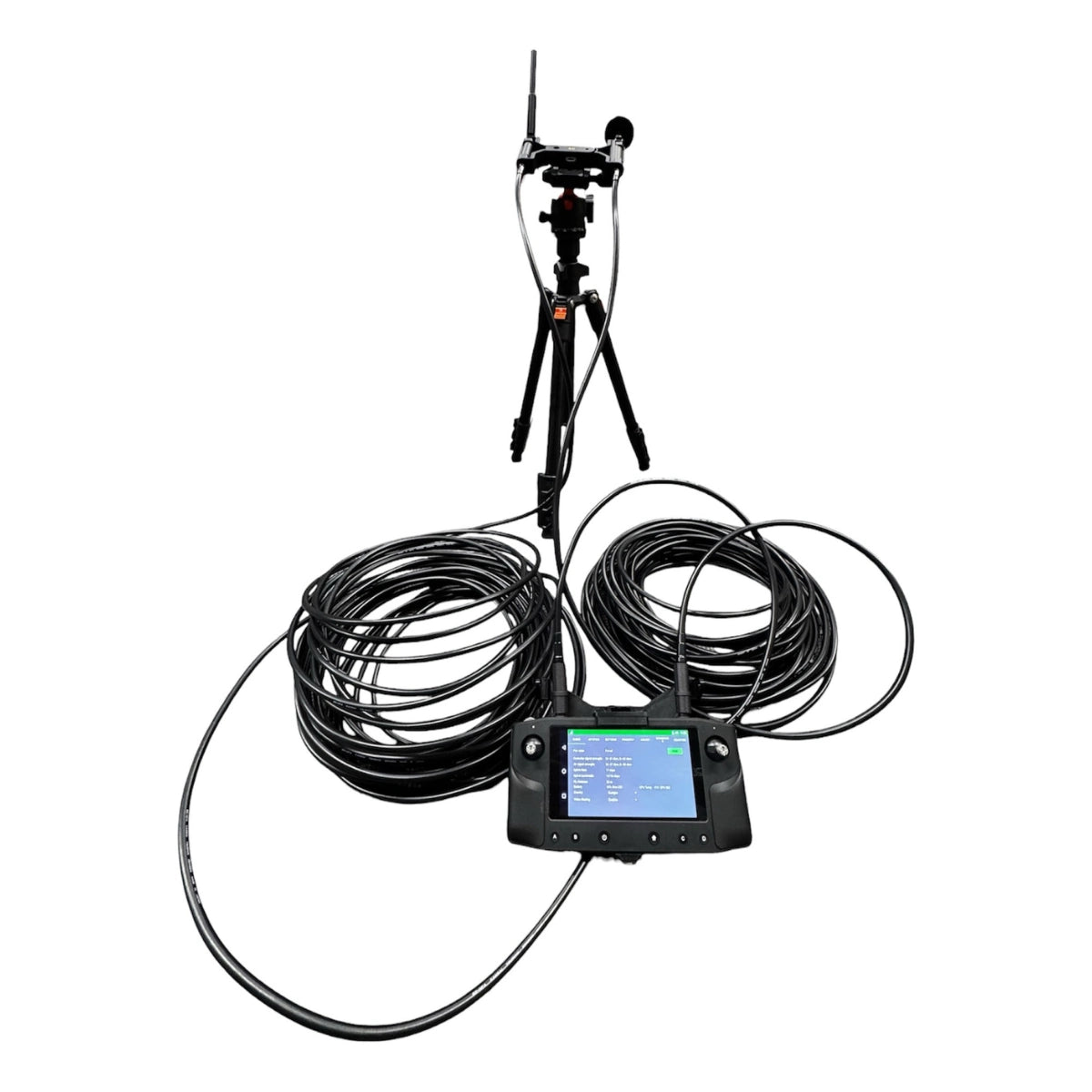
The Nolvis X1 Range Extender is a cable-and-antenna kit that keeps the X1 controller connected to its aircraft when steel walls or doors block a direct signal. Two 65.6 ft (20 m) coaxial cables carry the signal from the controller's antenna ports out to a directional antenna and an omnidirectional antenna, both held on one tripod. Position the tripod at the opening with a view of the aircraft, and the controller stays with the pilot in a safe location. Nothing in the kit is powered.

Link quality depends more on what stands in the way than on cable length. Nolvis testing found that the 20 m run added minimal attenuation, while a structure between antennas and aircraft caused FPV image break-up and lag. Pair the kit with the Nolvis X1 controller.

Key Features and Benefits

  • Cable run: two 65.6 ft (20 m) coaxial cables, one per side
  • Antenna pair: one directional and one omnidirectional, mounted together on the bracket
  • Remote placement: antennas sit near the aircraft while the pilot stays outside
  • Link quality: signal strength equals a direct connection over a clear path
  • Passive design: no battery, no charging, just connect and power the controller
  • Tripod mount: 1/4-20 UNC thread, 17.6 lb (8 kg) load rating
  • Data capacity: design uplink bandwidth reaches approx. 17,000 kbps in good conditions
  • Status display: five signal bars on the controller track link strength

Tank and shaft work puts steel between the pilot and the aircraft, and that is where flights get cut short. This kit keeps the link intact by moving only the antennas into the structure, so the operator can stay out. It sits alongside your confined-space procedures, not in place of them.

Dronefly is an authorized Nolvis distributor, so the Range Extender arrives as genuine Nolvis equipment. Order the Nolvis X1 Range Extender from Dronefly now.

  • Cable length: 65.6 ft (20 m) each, two cables
  • Cable type: 5D-HFA coaxial
  • Compatible controller: Nolvis X1 controller (sold separately)
  • Supported antennas: directional and omnidirectional, dual connection verified
  • Signal strength retention: equivalent to a direct connection, minimal attenuation verified
  • Max uplink bandwidth: up to approx. 17,000 kbps (design value under good radio conditions)
  • Verified flight mode: LIO mode
  • Mass (complete set): 24.5 lb (11.1 kg)
  • Tripod mounting thread: 1/4-20 UNC
  • Tripod load rating: 17.6 lb (8 kg)
  • 2x Extension cable, 65.6 ft (20 m)
  • 1x Antenna set (1 directional, 1 omnidirectional)
  • 2x Controller-end adapter
  • 1x Antenna-end adapter
  • 1x Antenna tripod
What is the Nolvis X1 Range Extender used for?

It lets you mount the X1 controller’s antennas near the aircraft while the pilot works from a safe spot. This helps in tanks, shafts, and other structures where metal walls and doors weaken a direct link. Two 65.6 ft (20 m) coaxial cables join the controller to the antennas.

What comes in the box?

You get two 20 m extension cables, a directional antenna, an omnidirectional antenna, and an antenna tripod. Two controller-end adapters and one antenna-end adapter are also included. The Nolvis X1 controller is sold separately.

Do I need a power source for it?

No. The kit has no battery or power module. It extends the link between the controller’s antenna ports and the antennas, so you connect the cables and switch the controller on.

How much signal do the long cables lose?

Very little. Nolvis testing showed signal strength over the 20 m cables matched a direct connection with a clear path. The biggest factor in link quality was whether anything stood between the antennas and the aircraft.